Geofencing Pet Collar 101: What a Safe Zone Alert Actually Means
 Avipsa Banerjee
·
September 28, 2026
·
3 min read
Avipsa Banerjee
·
September 28, 2026
·
3 min read
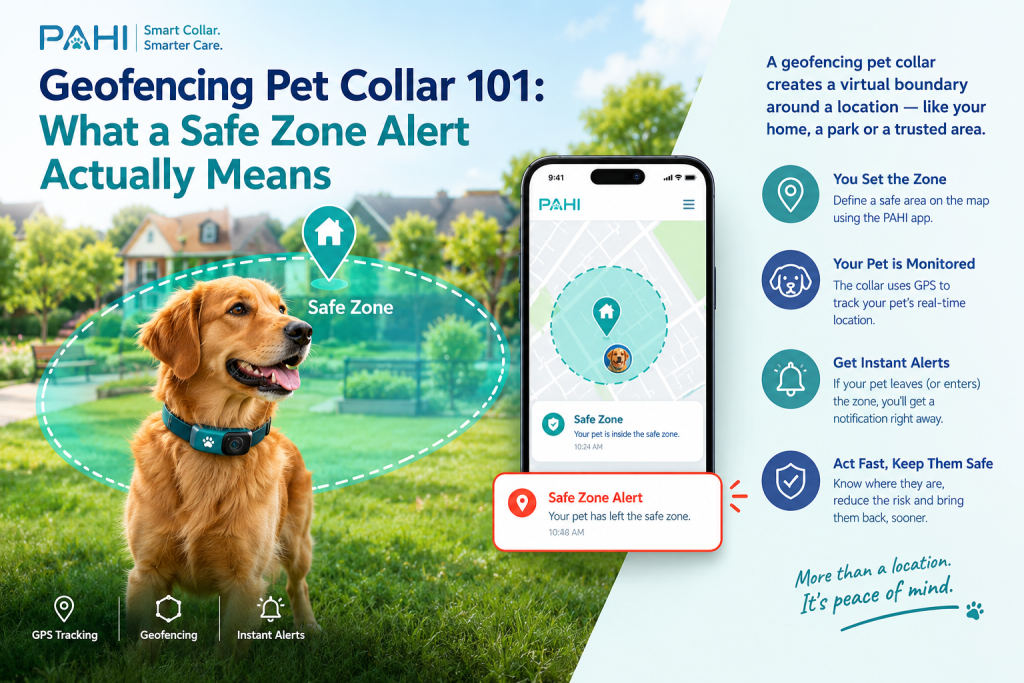
If you’ve ever seen the phrase “safe zone alert” on a pet tracker app and wondered what’s actually happening under the hood, you’re not alone. A geofencing pet collar sounds like sci-fi, but the idea is simple: draw an invisible line on a map, and get pinged the second your dog crosses it. The tricky part — the part most brands don’t explain — is what happens between “dog steps outside the line” and “notification hits your phone.”
What Geofencing Actually Is
Geofencing isn’t a physical fence at all. It’s a virtual boundary drawn on GPS coordinates — your yard, your street, a park perimeter — stored in an app. The collar constantly checks its own location against that boundary. Step outside it, and the system flags a breach. No wires, no buried cable, no shock collar involved. Just math, satellites, and a very fast comparison happening in the background.
How a “Safe Zone” Alert Actually Fires
Here’s the sequence: the collar’s GPS chip gets a location fix, compares it to your saved geofence, and if it’s outside the line, it pushes that event to a cellular network, which relays it to the app as a push notification. Sounds instant. It isn’t always. Cheaper trackers update location once a second and lean on single-frequency GPS accurate to about 15 feet — fine for “somewhere on this block,” not so fine for “already past the gate.” At full sprint, dogs cover 20 to 30 feet every second, so a laggy fix can mean the alert lands after the dog is already gone.
Why Accuracy and Speed Matter More Than the Marketing Says
This is the gap between a good geofencing pet collar and a merely okay one: update frequency and GPS precision. Systems that check location multiple times per second and use dual-frequency GPS (sub-2-foot accuracy) catch a breach almost the moment it happens, not thirty seconds later. That gap is exactly why nearly 15% of pet owners report losing a dog or cat at some point — and why the ones who get their pet back fast (93% of lost dogs eventually are, per ASPCA data) usually had a head start, not luck.
Geofencing Isn’t a Containment Fence — And That’s Fine
One common mix-up: geofencing alerts you, it doesn’t stop your dog. It’s not an invisible fence that corrects behavior — it’s an early-warning system. Some collars add vibration cues near the boundary, but the core job of geofencing is simple: tell the human, fast, the moment the line gets crossed, so the search starts in seconds instead of hours.
The Bottom Line
A safe zone alert is only as good as the GPS fix and network speed behind it. Before trusting any collar with your pet’s safety radius, ask how often it actually checks location — because in the seconds after a gate gets left open, that update rate is the whole ballgame.