Scared vs Aggressive Dog Body Language: How to Tell the Difference
 Avipsa Banerjee
·
October 10, 2026
·
3 min read
Avipsa Banerjee
·
October 10, 2026
·
3 min read
If you’ve ever frozen mid-walk wondering whether the dog in front of you is about to bolt or about to bite, you’re not alone. Scared vs aggressive dog body language looks confusingly similar at first glance — both can involve stiff bodies, raised hackles, even a growl. But once you know what to actually look for, the two are easy to tell apart, and reading it right can keep you (and your own dog) safe.
Scared Dog Body Language: What Fear Actually Looks Like
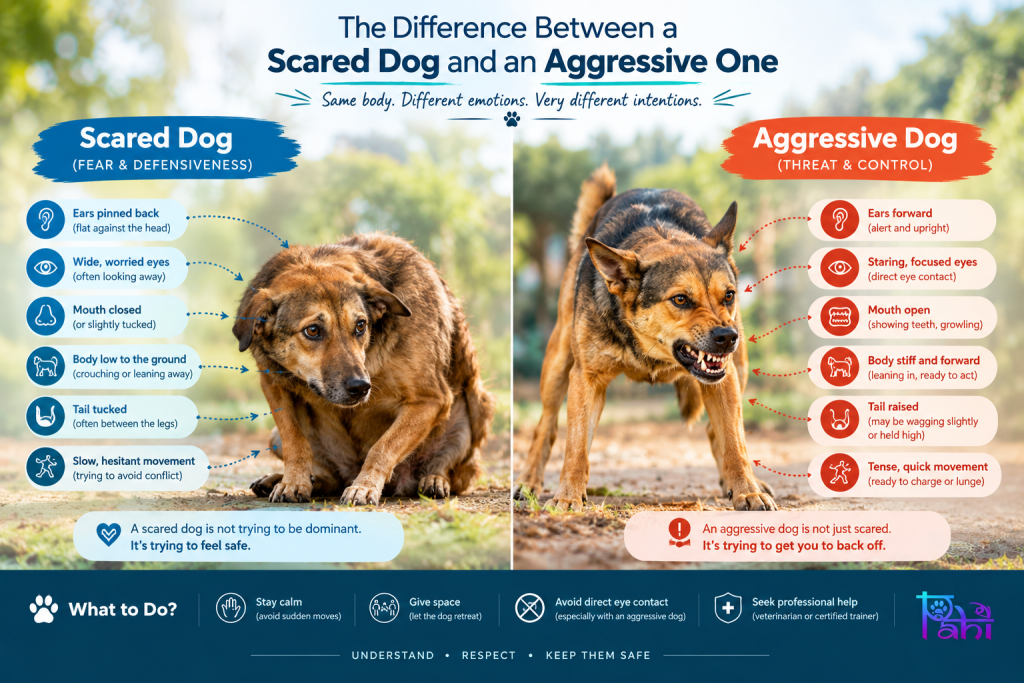
A frightened dog is trying to create distance, not close it. Watch for ears pinned flat, a tucked tail, a body held low or crouched, and eyes that look away or show “whale eye” (you can see the whites). Movement tends to be slow, hesitant, or aimed at escape. A scared dog isn’t trying to dominate anyone — it’s trying to feel safe. Even a growl or snap from a fearful dog is usually a last resort, not an opening move.
Aggressive Dog Body Language: What a Real Threat Looks Like
An aggressive dog is trying to make you back off, and its whole body says so. Think stiff, forward-leaning posture, ears up and forward, a hard unblinking stare, and a tail held high (sometimes stiffly wagging — which people mistake for friendliness). You’ll often see bared teeth, growling, or lunging, and unlike a scared dog, the behavior usually keeps escalating even if you step back.
The Overlapping Signals That Trip Everyone Up
Here’s the tricky part: raised hackles, growling, and even snapping can show up in both fear and aggression. That’s why trainers say to read the whole dog, not one signal in isolation. A stiff body plus direct staring plus forward movement points to aggression. A low body plus tucked tail plus retreating points to fear. Context matters too — a dog guarding its food is a different story than one startled by a stranger.
What to Do Either Way
Whether a dog is scared or aggressive, the playbook is similar at first: stay calm, avoid sudden movements, skip direct eye contact, and give the dog space to decompress. If the behavior is frequent, intense, or you just can’t read it confidently, loop in a vet or certified trainer — persistent fear and reactivity are both manageable with the right help.
Understanding this distinction isn’t just good manners around dogs you meet — it’s useful for your own pet too, especially in moments of stress like vet visits, fireworks, or new environments where fear can quickly tip into defensive behavior.