Cat Tail Body Language 101: What Their Tail Is Really Saying
 Subhrangshu Podder
·
September 9, 2026
·
3 min read
Subhrangshu Podder
·
September 9, 2026
·
3 min read
If you want to know what your cat is actually thinking, stop staring at their face and look at their tail instead. Cat tail body language is one of the clearest windows into your cat’s mood — arguably clearer than a purr, which can mean anything from “I’m thrilled” to “I’m in pain.” The tail, on the other hand, rarely lies.
The Straight-Up Greeting
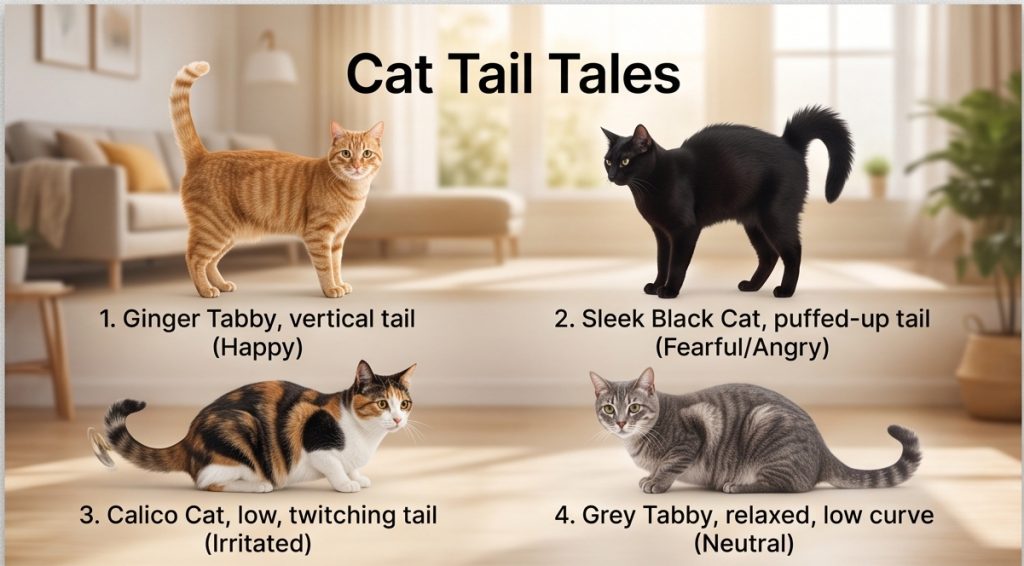
A tail held high and straight, often with a gentle curl at the tip like a question mark, is your cat’s version of a wave hello. Researchers have found that cats reliably approach other cats — and even cat-shaped silhouettes — with their tails up, while avoiding ones with lowered tails. If your cat trots toward you tail-first, that’s confidence and friendliness, not indifference.
Puffed Up Means Back Off
A tail that suddenly triples in size, especially paired with an arched back, isn’t your cat being dramatic for fun. It’s a genuine “I feel threatened” reflex, meant to make them look bigger to whatever just spooked them. The right move is space, not a comforting pet — save the affection for when the fur settles back down.
Swish, Twitch, or Thrash — They’re Not the Same
Tail movement is where most owners get confused. A slow, deliberate swish usually means your cat is locked onto something — a bird outside, a toy, your ankle — and a pounce might be seconds away. A quick flick of just the tip signals mild irritation or intense focus. But a hard, full-tail thrash or a thump against the floor is a clear “stop right now,” often showing up mid-petting session, right before the nip nobody saw coming.
Wrapped Around You? That’s Real Affection
Cats have scent glands along their tails, so when they wrap it around your leg, arm, or another pet, they’re not just being cute — they’re marking you as theirs. It’s the feline equivalent of a hug, and one of the clearest “I trust you” signals a cat can give a human.
Why Cat Tail Body Language Matters More Than You Think
Cats are experts at hiding pain and stress until things are serious, which is exactly why body language — tail included — is often the earliest warning sign something’s off. A tail held unusually low, tucked tight, or wrapped around the body for no obvious reason isn’t something to brush aside. It’s often the smallest tells that matter most, which is the same principle behind PAHI’s Dotty AI: trained to notice subtle shifts in a pet’s behavior before they turn into a vet visit.